Tag Archive for: Global

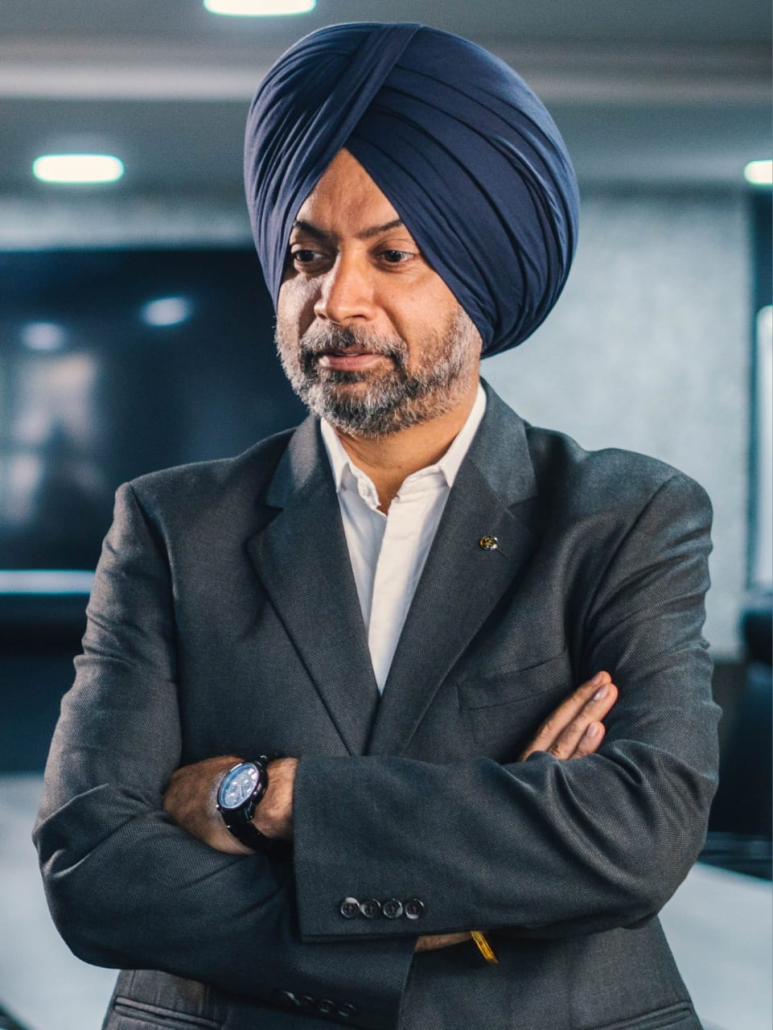
Miller in Spotlight – Mr. Cheran K, CEO – Kaleesuwari Refinery Pvt. Ltd.

Q. Kaleesuwari has been a household name for over five decades. What was the defining moment that led the company to transition from being a provider of ‘pure oil’ to becoming a champion of ‘fortified nutrition’ through initiatives like the Vita D3+ campaign?

For over five decades, Kaleesuwari built its reputation on purity and trust. However, as we engaged more deeply with consumers, nutrition experts, and public-health stakeholders, one reality became clear — India’s hidden hunger, especially Vitamin A and D deficiency, cannot be addressed by availability of food alone; it requires nutrient-enriched staples.
Edible oil is consumed daily across socio-economic segments and geographies. That makes it a powerful and scalable nutrition delivery vehicle. This insight became the defining moment for us. The Vita D initiative was therefore not just a product upgrade, but a purpose-led transition — from being a provider of pure oil to becoming a partner in preventive nutrition.
It aligns perfectly with our long-standing philosophy: what reaches the consumer’s kitchen must improve their wellbeing, not just meet a functional need.

Q. What is the biggest challenge Kaleesuwari has faced in EO fortification?


The most significant challenge has been balancing nutritional compliance with commercial and sensory expectations.
Fortification requires:
• highly precise micronutrient dosing
• stability across the product’s shelf life
• zero impact on taste, aroma, and appearance
At the same time, it must remain affordable for mass consumers.
In the early stages, creating process discipline, supplier alignment for premix quality, and real-time monitoring systems were critical. Today, the challenge has evolved into driving consumer awareness so that fortification is valued and not seen as just another label claim.

Q. With your rigorous ’80-point quality check’ process, how has Kaleesuwari integrated EO fortification into its manufacturing without compromising the taste and stability that consumers expect from brands like Gold Winner and Cardia?
Our 80-point quality check system was actually an enabler for seamless integration.
Fortification has been embedded at three levels:

Output assurance
• Retention sample testing for micronutrient stability across shelf life
• Sensory benchmarking against non-fortified control oils
This ensures that brands like Gold Winner and Cardia retain their same taste, lightness, and cooking performance, while delivering added nutrition — which is non-negotiable for us.

Input control
• Validation of certified premix suppliers
• Stability and compatibility testing with different oil matrices

Process control
• Automated and calibrated dosing systems
• Homogeneity validation at defined batch intervals
• In-line and post-blend sampling protocols

Q. How do your quality, operations, and procurement teams work together to ensure consistent standards and reliable supply to consumers?


Fortification success depends on synchronised execution across procurement, operations, and quality:
• Procurement ensures long-term partnerships with certified premix suppliers, dual sourcing strategies, and strict inbound quality protocols.
• Operations manages calibrated dosing, batch traceability, and process standardisation across plants.
• Quality drives validation, periodic audits, and regulatory compliance, including FSSAI fortification norms.
We operate through a closed-loop review system, where deviations — however small — trigger root-cause analysis and corrective action. This guarantees that the consumer gets the same nutritional assurance in every pack, every time.


Q. India faces a significant challenge with Vitamin A and D deficiencies. How does Kaleesuwari view its role as a miller in the ‘Millers for Nutrition’ coalition to help bridge this nutritional gap, especially for semi-urban and rural populations?


As a leading edible-oil miller, we believe our responsibility goes beyond manufacturing.
Through the Millers for Nutrition coalition, our focus is on:
• Making fortified oil accessible to semi-urban and rural households
• Supporting large-scale behaviour-change communication
• Partnering in institutional and public-distribution channels
• Sharing best practices in process, quality, and compliance
Because edible oil has near-universal penetration, millers like us can help bridge the micronutrient gap at population scale without requiring any change in food habits.

Q. In your experience, what is the biggest challenge in moving the needle on consumer awareness for fortified foods, and how are you tackling it?


The biggest challenge is that fortification is an invisible benefit.
Consumers can see purity and price — but they cannot see micronutrients.
Our approach has been to:
• Simplify communication through campaigns like Vita D
• Use on-pack education with the +F logo
• Drive doctor, nutritionist, and digital advocacy
• Position fortification as family wellness, not a technical feature
The shift we are working towards is from “oil that cooks well” to “oil that cares for your family’s health.”

Q. As our ‘Miller in Spotlight,’ how does Kaleesuwari envision the long-term roadmap for its fortification journey?


Our fortification roadmap is built on three pillars:

Nutrition leadership
• Continuous improvement in micronutrient stability
• Collaboration with policymakers and industry bodies
• Consumer education at scale


Our long-term vision is clear:
Every Kaleesuwari pack should not only deliver purity and performance, but also measurable nutritional value to the Indian consumer.

1. Universalisation
Ensuring fortification across our entire edible-oil portfolio so that nutrition is not a premium feature but a standard.

2. Accessibility
Taking fortified oils deeper into:
• rural markets
• value packs
• institutional channels

3. Nutrition leadership
• Continuous improvement in micronutrient stability
• Collaboration with policymakers and industry bodies
• Consumer education at scale

Our long-term vision is clear:
Every Kaleesuwari pack should not only deliver purity and performance, but also measurable nutritional value to the Indian consumer.

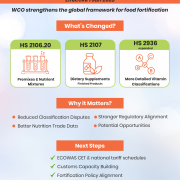
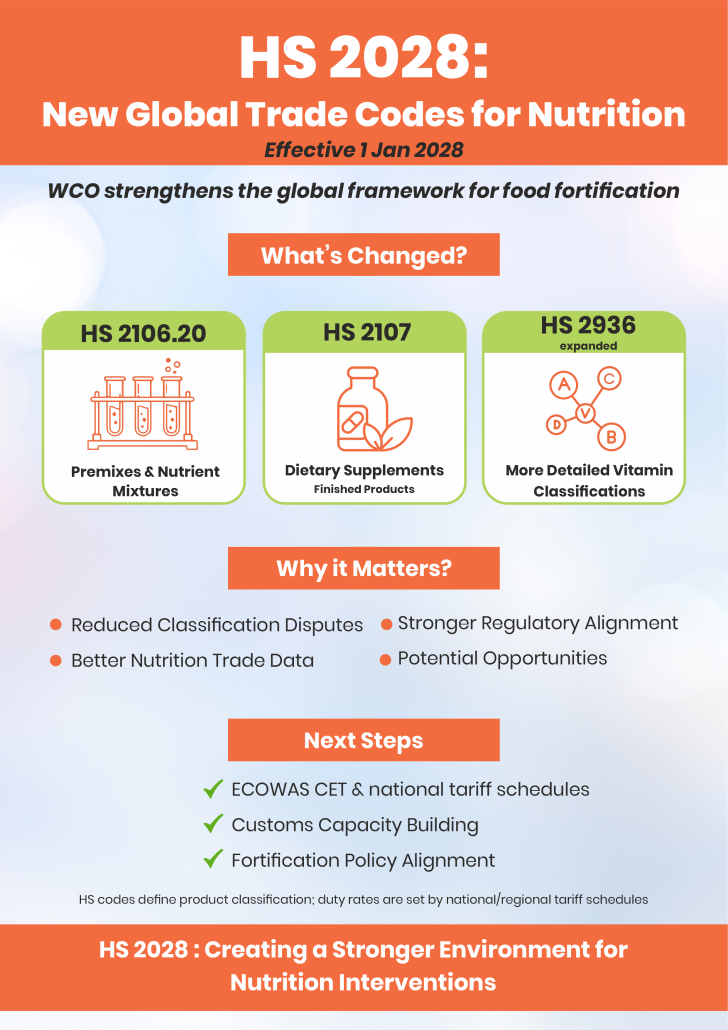
WCO adopts new global trade codes for nutrition products (HS 2028)


The World Customs Organization (WCO) has published the HS 2028 amendments, effective 1 January 2028, introducing new global trade codes for key nutrition products relevant to food fortification.
These changes follow a formal amendment application by Swiss Customs, with technical support from Global Customs Compliance and the Global Alliance for Improved Nutrition (GAIN), and were approved through the WCO’s Harmonized System Committee.

🔍 What’s changed?
• HS 2106.20 – A new subheading for premixes and nutrient mixtures used as industrial inputs for fortified foods and beverages
• HS 2107 – A new heading for dietary supplements as finished consumer products, clearly separated from industrial premixes
• Expanded and more detailed classifications for vitamins under HS 2936
📌 Important note:
HS 2028 does not change duty rates on its own. It improves product classification, enabling countries and regions to apply clearer, more consistent tariff treatment once adopted into national schedules.

⚙️ Why this matters for millers
✔ Reduced clearance delays and classification disputes
✔ Better identification of premix inputs versus finished supplements
✔ Stronger trade data to support informed policy and tariff discussions
✔ A clearer framework for authorities to differentiate inputs from consumer products

➡️ What’s next?
Millers for Nutrition is engaging with ECOWAS and national counterparts on:
• Integration of HS 2028 into the ECOWAS Common External Tariff (CET) and national schedules
• Capacity-building for customs officials and brokers
• Alignment with ongoing food fortification policy efforts
We will continue to share updates as countries begin transposing HS 2028 ahead of 2028.

Millers for Nutrition Shines at Gulfood 2026

Millers for Nutrition Shines at Gulfood 2026

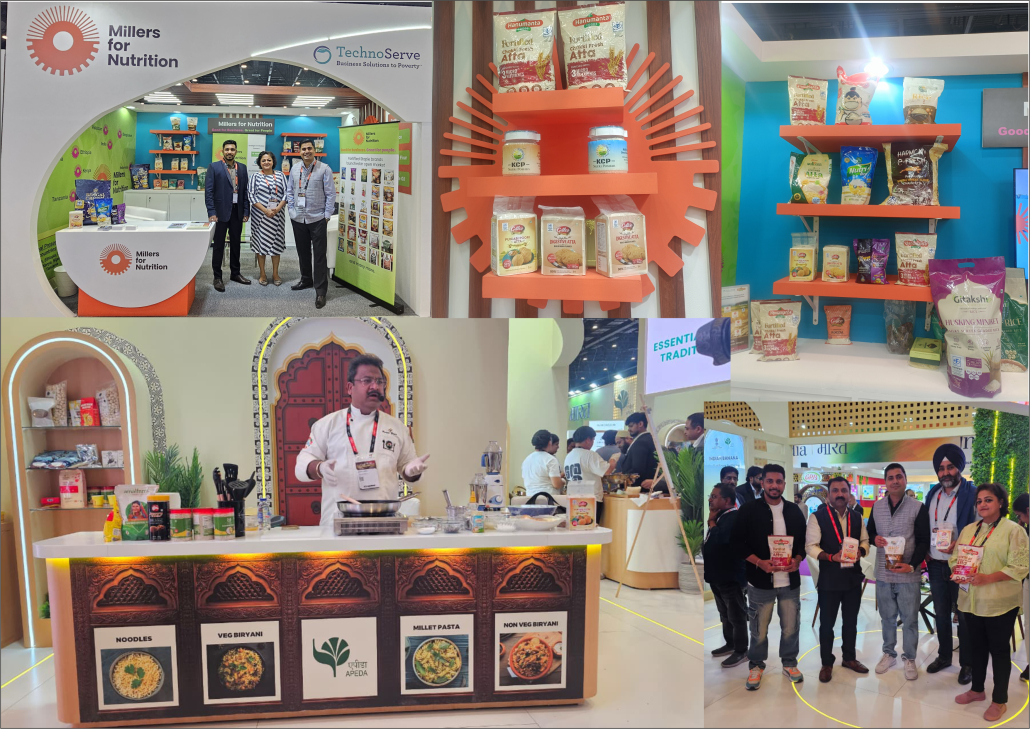
Millers for Nutrition made a strong and purposeful presence at Gulfood 2026 (January 26–30), one of the world’s largest food and beverage platforms, using the global stage to spotlight how fortified staples can drive both nutrition impact and commercial growth. Across five high-energy days, the pavilion became a hub for conversations around quality, scale, and global readiness—bringing the mission of fighting malnutrition into direct dialogue with international trade.

A key highlight of the event was the participation of our Champion Millers from across Asia, who engaged with global buyers, exporters, and distributors to explore new export pathways for fortified rice and wheat flour. These interactions translated the coalition’s nutrition mandate into tangible business opportunities, reinforcing confidence in fortified staples as competitive, market-ready products.

The visit of Dr. C. B. Singh, Deputy General Manager at the Agricultural and Processed Food Products Export Development Authority (APEDA), further strengthened this narrative. His engagement underscored India’s growing leadership in the global fortified rice movement and highlighted the enabling role of policy and export ecosystems in scaling nutrition-forward solutions.

Adding a compelling experiential dimension, Celebrity Chef Dr. Rajeev Goyal hosted a live culinary showcase using fortified wheat flour, demonstrating that nutrition-enhanced products deliver on taste, versatility, and consumer appeal—without compromise.

By convening millers, policymakers, buyers, and technical experts under one roof, Millers for Nutrition used Gulfood 2026 as a true commercial catalyst. The event reaffirmed a powerful message: fortified foods are not only a public health imperative, but a viable, scalable, and globally competitive business opportunity for forward-looking millers.

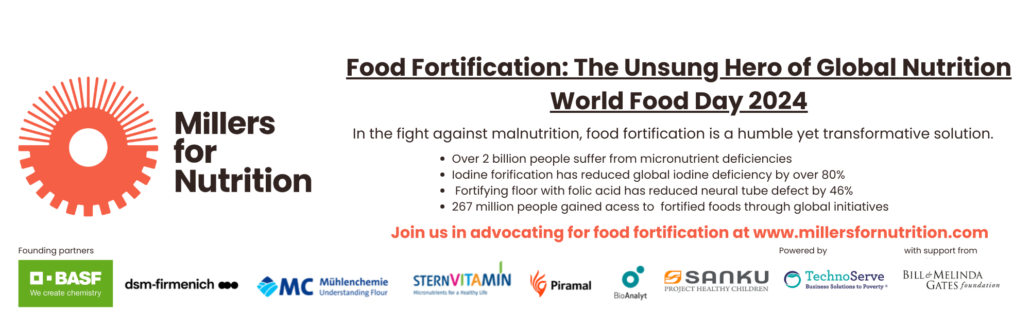
Food Fortification: The Unsung Hero of Global Nutrition – World Food Day 2024

In the fight against malnutrition, there is a humble, yet transformative solution that has quietly improved the health of billions around the world: food fortification. This simple intervention—adding essential vitamins and minerals to staple foods—has made a profound impact on global health, yet it often goes unnoticed. As we celebrate World Food Day 2024, it’s time to shine a spotlight on this unsung hero, whose benefits are more relevant today than ever before.

Food fortification isn’t just about nutrition—it’s about improving lives, economies, and the future of our world. It’s the reason iodine deficiency disorders have nearly disappeared, why devastating diseases like beriberi and pellagra are now rare, and why the rates of neural tube defects, a major cause of infant mortality, have plummeted. This simple, cost-effective solution has saved millions of lives and has quietly been a cornerstone of public health for decades. Yet, in global conversations on nutrition, it rarely takes center stage.

A Silent, Global Crisis

Right now, over 2 billion people—almost one in three—suffer from “hidden hunger.” This isn’t about empty stomachs; it’s about the lack of essential nutrients like iron, iodine, vitamin A, and folic acid, which are crucial for healthy development. The consequences are severe: stunted growth, weakened immune systems, cognitive impairments, and even death. For example, iron deficiency affects 1.6 billion people and contributes to 20% of maternal deaths worldwide. This is more than just a health issue—it’s an economic one too. According to the World Bank, micronutrient deficiencies cost developing countries up to $3 billion annually in lost productivity and healthcare expenses.

The Power of Fortification: Proven Results

Food fortification is one of the most powerful tools in the fight against hidden hunger. Take iodized salt, for example. Since its introduction in the 1990s, iodine fortification has reduced global iodine deficiency by over 80%, virtually eliminating iodine deficiency disorders like goiter. Nearly 90% of the world’s population now consumes iodized salt, saving millions of lives and improving cognitive development, especially in children.

Similarly, fortifying wheat and maize flour with folic acid has been a game-changer in the fight against birth defects. In countries with mandatory fortification, neural tube defects—such as spina bifida—have dropped by 46%. In the U.S. alone, fortification has prevented 1,300 neural tube defect-affected pregnancies every year since 1998. These numbers aren’t just statistics—they represent lives changed and futures transformed.

In Zambia, where flour is fortified with iron, anemia in women of reproductive age dropped by 10% in just a few years. The impact is clear: fortification works, it’s affordable, and it reaches people where they are—no drastic changes in behavior or diet needed.

A Changing World, A Growing Need

The world is changing fast, and with it, so are people’s diets. By 2050, 68% of the global population will live in urban areas, up from just 30% in 1950. This shift toward urban living is driving changes in food consumption, with more people relying on processed and packaged foods. While these foods are convenient, they often lack the essential nutrients found in traditional diets. In sub-Saharan Africa, urbanization is leading to increased consumption of refined grains, stripped of nutrients during processing. The result? A growing nutritional gap, one that food fortification is perfectly poised to fill.

The Global Nutrition Report of 2021 warns that in low- and middle-income countries, diets are becoming increasingly energy-dense but nutrient-poor, contributing to rising obesity and non-communicable diseases like diabetes. In these environments, fortifying staple foods with critical nutrients like iron, vitamin A, and folic acid can address the double burden of malnutrition—undernutrition and obesity—at the same time. Food fortification offers a pragmatic solution that can adapt to these changing realities without overhauling dietary habits.

A Pragmatic Approach: TechnoServe’s Millers for Nutrition

So, how do we make food fortification even more effective? By working with the people who make the food we eat. That’s exactly what TechnoServe’s Millers for Nutrition initiative does—engage with private-sector millers, the unsung heroes who ensure that the food reaching millions of people is not just filling, but nutritious.

Unlike traditional approaches that focus on government regulations, TechnoServe’s strategy is simple but powerful: we give millers the tools, technical assistance, and training they need to voluntarily fortify their products. Our approach is pragmatic, scalable, and sustainable. By 2023, TechnoServe had partnered with 500 millers across Africa and Asia, impacting the nutrition of over 200 million people.

The initiative is driven by competition and innovation. For instance, in Kenya and Nigeria, TechnoServe introduced the Kenya Millers Fortification Index (KMFI) and the Micronutrient Fortification Index (MFI). These indices encourage millers to compete on quality and compliance. The result? A 40% improvement in fortification levels among participating millers in Kenya, ensuring that fortified products meet nutritional standards and reach those who need them most.

Scaling Up: The Future of Fortification

The successes seen in Kenya, Nigeria, Zambia, and other countries are just the beginning. More than 85 countries now have mandatory fortification programs, but billions of people—especially in low- and middle-income countries—still do not have consistent access to fortified foods. Scaling up fortification efforts, expanding access, and ensuring that fortified foods reach the most vulnerable populations is the next frontier.

On this World Food Day 2024, the message is clear: food fortification is a simple, effective solution that remains essential in the fight against malnutrition. As the world’s populations shift towards urban living and dietary patterns evolve, fortification is becoming more critical than ever before. Through initiatives like Millers for Nutrition, TechnoServe is showing how public-private collaboration can drive real, lasting change.

Together, we have the tools to build a healthier, more resilient world—one fortified grain at a time. Food fortification may be the unsung hero of global nutrition, but its power to improve lives is undeniable. Let’s make sure it gets the recognition it deserves as a cornerstone of our global strategy to end malnutrition. After all, sometimes the simplest solutions are the most powerful.

Source: Rizwuan Yusifali, Program Director, Inspiring Good Nutrition Initiative Through Enterprise (IGNITE)

Empowering Millers: The Millers for Nutrition Coalition

Role of BioAnalyt

Website Relaunch

We’re excited to unveil new functionalities on the Millers for Nutrition website, bringing us closer to reaching our year one goal of 300 millers onboarded. We’re excited to share that we’ve  already registered  290 millers! Additionally, we’ve launched a revised TA/TTA framework system to optimize processes. Other updated functionalities in our Knowledge Hub. Partners and SFPs are encouraged to contribute resources to the Knowledge Hub to  ensure it remains a dynamic source of information for millers. If you have any queries or encounter issues, please reach out to [rmohamed@tns.org], and our team will be delighted to assist you.  

Tag Archive for: Global

Nothing Found

Sorry, no posts matched your criteria