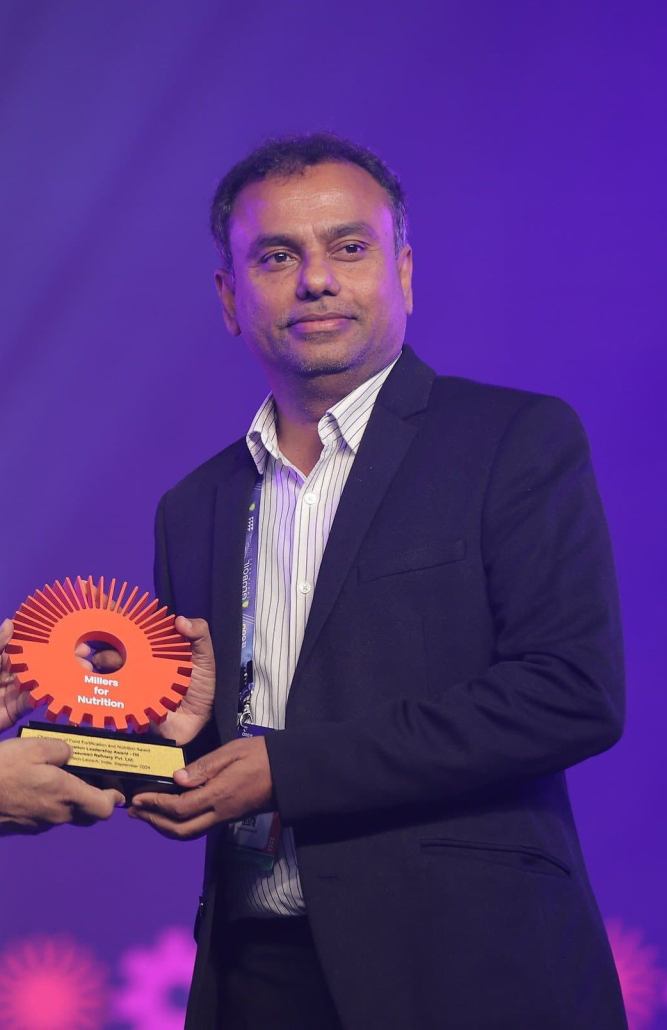
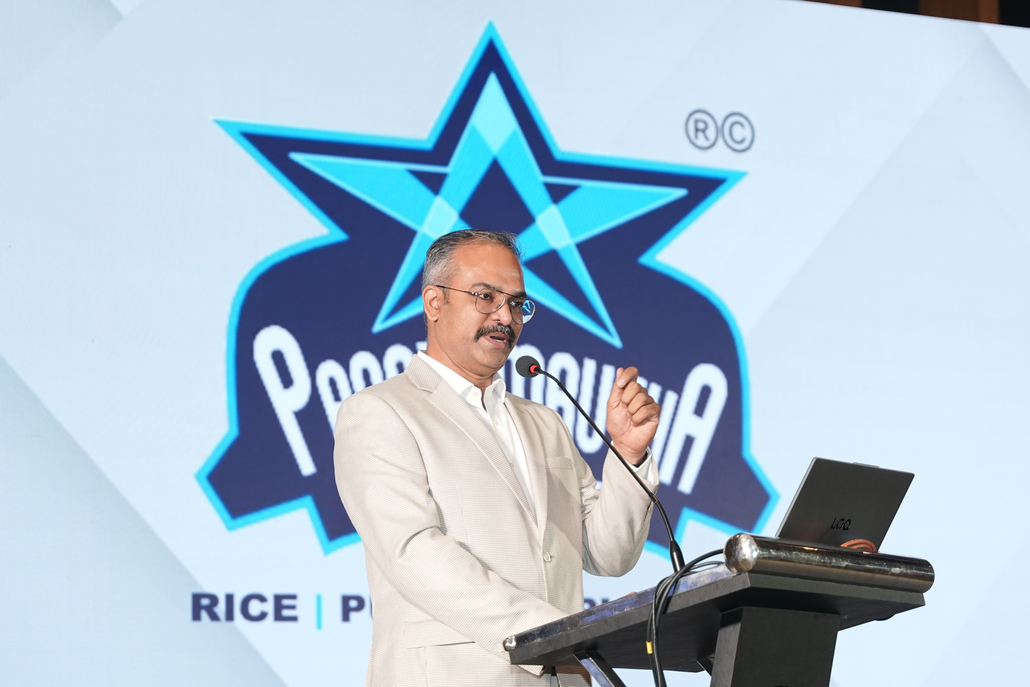
Miller in Spotlight – Mr. Jambulingappa Hosmani, Managing Director – Panchamrutha Industries Pvt. Ltd. India
1. Panchamrutha Industries has evolved from a traditional grain business into a company with a growing focus on nutrition-led food products. What has driven this journey, and where does food fortification fit into your broader vision for the company?
JH: “Our journey has been driven by a simple belief: food should not just satisfy hunger; it should also contribute to better nutrition.
With over two decades of experience in the food industry, we have evolved from traditional grain trading to value-added, nutrition-focused food processing, combining consumer trust with modern technology.
Food fortification is central to this transformation. Recognising the widespread challenge of micronutrient deficiencies in India, we introduced fortified rice in 2023, followed by our Panchamrutha Deluxe Fortified Rice range, enriched with 9 essential vitamins and minerals, while retaining the familiar taste and cooking characteristics of regular rice.
Our vision is to make nutrition accessible, affordable and part of everyday meals, rather than a luxury. Going forward, we aim to expand our portfolio of fortified staples and nutrition-focused food products, contributing to a healthier India.
At Panchamrutha, we believe the future of food is not just about feeding more people, but nourishing them better.’’
2. Panchamrutha is one of the first movers in launching fortified rice in consumer packs in the commercial retail market and has since expanded its offering. What have you learned from bringing fortified rice to the market, particularly in terms of consumer expectations, affordability and building trust in the category?
JH: “Being among the early movers to introduce fortified rice in consumer packs in India’s commercial retail market has been both a responsibility and a valuable learning experience.
Our biggest learning is that consumers are willing to embrace better nutrition when it comes without compromising on taste, quality or affordability.
Initially, consumer awareness about fortified rice was limited. We realised that educating consumers about the importance of essential vitamins and minerals was just as important as introducing the product itself.
Affordability has been another key factor. We strongly believe that better nutrition should be accessible to every household, not restricted to premium consumers. Our focus has therefore been on offering fortified rice at competitive prices while maintaining consistent quality.
Building trust requires transparency, consumer education and delivering a consistent product experience. By combining familiar rice varieties like Sonamasuri and Lachkari with added micronutrients, we are making fortified nutrition a practical part of everyday meals.
Our ultimate goal is to make fortified rice a household choice, not just a health-conscious alternative.”
3. Your recent launch of Panchamrutha Deluxe Fortified Rice brings nine essential vitamins and minerals to a staple that is part of everyday diets. How do you see the role of millers in making nutrition more accessible without making fortified products feel like a premium or specialised offering?
JH: “Millers have a crucial role in bridging the gap between food security and nutritional security. Since rice is consumed daily by millions of Indian households, fortification offers an opportunity to improve micronutrient intake without changing people’s eating habits.
At Panchamrutha, our philosophy is simple: better nutrition should be a standard, not a premium.
With the launch of Panchamrutha Deluxe Fortified Rice, enriched with nine essential vitamins and minerals, our focus is on combining nutritional value with the familiar taste, quality and affordability consumers expect from their everyday rice.
I believe millers must move beyond conventional processing and become active contributors to public nutrition. By adopting fortification technology, maintaining consistent quality standards and achieving economies of scale, we can make fortified staples more affordable and widely available.
Our vision is to make fortified rice an everyday household choice, where better nutrition comes naturally with the food families already trust.
Ultimately, the success of food fortification lies not in positioning it as a specialised product, but in making it accessible to every household.’’
4. Quality is central to building consumer confidence in fortified staples. What steps has Panchamrutha taken across production, fortification and quality assurance to ensure that consumers get consistent nutritional value while retaining the taste, appearance and cooking characteristics they expect from rice?
JH: “At Panchamrutha, we believe that fortification should enhance the nutritional value of rice without compromising the quality and experience consumers have trusted for years.
Our approach focuses on three key areas: careful selection of rice, controlled fortification and consistent quality assurance.
We emphasise sourcing quality rice, maintaining uniform grain characteristics and incorporating fortified rice kernels in accordance with prescribed FSSAI standards. Proper blending and process monitoring are essential to achieving consistent micronutrient distribution across batches.
Equally important is preserving the familiar taste, texture, appearance and cooking characteristics of popular varieties such as Sonamasuri and Lachkari, ensuring consumers can continue enjoying their everyday meals without changing their cooking habits.
We recognise that nutritional consistency requires continuous attention to raw materials, processing, packaging and quality verification.
For us, quality and nutrition must go hand in hand. Our objective is to deliver the same trusted rice experience with the added benefit of essential vitamins and minerals, making better nutrition a seamless part of everyday life.’’
5. Looking ahead, what do you believe needs to happen for fortified staples to move from being an emerging category to becoming a mainstream choice for Indian consumers—and what role do you see Panchamrutha and the wider milling industry playing in that journey?
JH: “For fortified staples to become mainstream in India, we need to focus on three fundamentals: consumer awareness, affordability and accessibility. Consumers must understand the benefits of food fortification and feel confident that better nutrition does not mean compromising on taste, quality or price.
I strongly believe that fortification should become an integral part of everyday food processing rather than remain a specialised product category.
The milling industry has a significant responsibility in this transformation. By embracing modern fortification technologies, maintaining consistent quality standards and working collectively with policymakers, nutrition experts and retailers, we can make fortified staples available to a much wider population.
At Panchamrutha, our vision is to lead by example—expanding our fortified product portfolio, strengthening consumer awareness and making nutrition-focused staples affordable for Indian households.
Our ambition is to make fortified foods a natural part of every Indian kitchen, contributing to a healthier and nutritionally stronger India.
Ultimately, the true success of fortification will be when consumers choose fortified staples not because they are different, but because they have become a trusted part of everyday life.”
6. As a leader, what has been the most rewarding part of seeing Panchamrutha enter the food fortification space, and what keeps you motivated to continue investing in nutrition-focused products?
JH: “The most rewarding part of this journey has been seeing Panchamrutha evolve from a traditional food business into a company that can make a meaningful contribution to everyday nutrition.
For me, the greatest satisfaction comes from knowing that the food we produce has the potential to make a positive difference in the lives of families.
Introducing fortified rice into the commercial retail market was not just a business decision; it was a step towards addressing the challenge of micronutrient deficiencies through foods people already consume every day.
What keeps me motivated is the opportunity to combine our two decades of industry experience with innovation and a larger social purpose. I firmly believe that businesses have a responsibility to contribute to society beyond commercial success.
At Panchamrutha, we see nutrition-focused products not merely as a growth opportunity but as a long-term commitment to consumers.
My vision is simple: Panchamrutha should be remembered not just for the food we sell, but for the positive difference we make to people’s nutrition and well-being.
That purpose continues to inspire us to innovate, invest and make better nutrition accessible to more Indian households.’’